


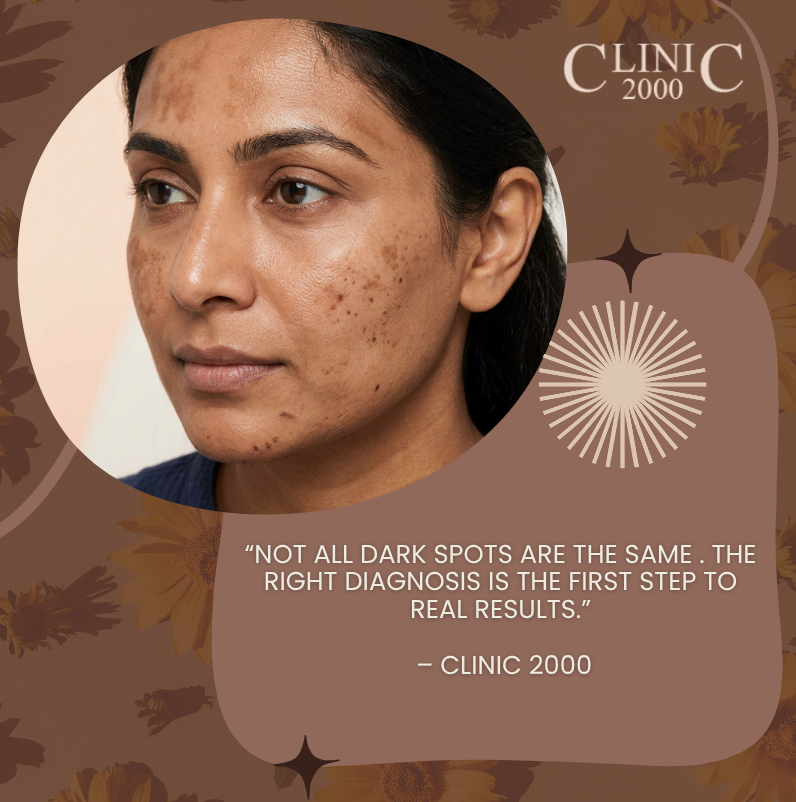
You’ve noticed patches of darker skin on your face. Maybe they appeared after pregnancy, a few summers of sun exposure, or they just seemed to show up one day without any clear reason. You try brightening creams, home remedies, and face packs but nothing seems to work.
Here’s the thing: before you can treat dark spots or discoloration effectively, you need to know what you’re actually dealing with. Melasma and hyperpigmentation are often used interchangeably, but they are not the same condition. They have different causes, different patterns, and require different treatments.
In this blog, we break down the key differences between the two, help you identify which one you might have, and explain what actually works to treat each condition, including the advanced options available at Clinic 2000, Hyderabad.
What Is Pigmentation?
Pigmentation is an umbrella term for any condition that causes uneven skin colour or darkening. It occurs when the skin produces too much melanin, the natural pigment that gives skin its colour. This overproduction can be triggered by many factors and can appear anywhere on the body.
Common types of pigmentation include:
• Post-inflammatory hyperpigmentation (PIH) – dark spots left behind after acne, injuries, or rashes
• Sunspots (solar lentigines) – flat brown spots caused by long-term UV exposure
• Freckles – small, flat spots that may darken with sun exposure
• Age spots – dark marks that develop as skin ages and is repeatedly exposed to the sun
What these all share is that they are reactive, something triggers the skin to produce excess melanin in a specific area, and a dark patch appears.
What Is Melasma?
Melasma is a specific and more complex type of pigmentation. It appears as symmetrical, brown or greyish-brown patches, most commonly on the cheeks, forehead, upper lip, nose bridge, and chin. It is significantly more common in women, particularly those with medium to dark skin tones.
Melasma is driven by a combination of factors:
• Hormonal changes – pregnancy (often called the ‘mask of pregnancy’), birth control pills, or hormonal therapy
• UV exposure – sunlight triggers and worsens melasma dramatically
• Genetics – a family history of melasma increases your risk
• Thyroid dysfunction – linked to melasma in some cases
Unlike regular dark spots, melasma tends to be deeper in the skin layers, more widespread, and significantly harder to treat. It can also recur even after successful treatment if sun protection is not maintained.
Key Differences: Melasma vs. Hyperpigmentation
Pattern and Appearance
Melasma forms in large, symmetrical patches across both sides of the face. Hyperpigmentation tends to appear as scattered or localised spots, often in areas of previous inflammation or sun damage.
Trigger
Melasma is primarily hormonal. Hyperpigmentation is triggered by injury, inflammation, acne, or UV damage. If your dark patches appeared during or after pregnancy, melasma is the more likely cause.
Depth
Melasma can affect both the superficial (epidermal) and deeper (dermal) layers of skin. Most hyperpigmentation is epidermal, making it more responsive to surface treatments like peels and brightening serums.
Difficulty of Treatment
Hyperpigmentation, especially PIH from acne, often fades on its own over months with proper sun protection and skincare. Melasma is chronic, tends to be stubborn, and requires medical-grade treatment for meaningful improvement.
Effective Treatments for Pigmentation
Depending on the type and severity of your pigmentation, treatment options range from topical solutions to clinical procedures:
1. Chemical Peels
Chemical peels exfoliate the skin’s surface, removing dead cells and encouraging new, even-toned skin to emerge. At Clinic 2000, the Super Peel and C2K Peel are designed to address pigmentation, acne spots, and dullness. These peels are formulated to suit Indian skin tones and deliver visible results safely.
2. Laser Treatment
Laser therapy targets excess melanin in the skin without damaging surrounding tissue. It is particularly effective for deep pigmentation, stubborn dark spots, and age-related discoloration. The E+ Laser at Clinic 2000 is FDA and CE approved and can treat pigmentation at multiple skin depths.
3. Microdermabrasion
Microdermabrasion is a non-invasive procedure that polishes the skin surface to remove dead cells and stimulate new cell growth. It works well for superficial hyperpigmentation and gives the skin a brighter, more even appearance.
4. HydraFacial
The HydraFacial combines cleansing, exfoliation, extraction, and hydration in a single session. It helps fade mild pigmentation, improve overall skin tone, and boost skin radiance. It is suitable for all skin types with zero downtime.
5. Prescription Topical Agents
For melasma in particular, topical treatments like hydroquinone, kojic acid, azelaic acid, or retinoids may be prescribed alongside in-clinic procedures to enhance and maintain results.
How Clinic 2000 Diagnoses and Treats Pigmentation
At Clinic 2000, we do not believe in a one-size-fits-all approach. When you visit us for a pigmentation concern, our dermatologist examines the pattern, depth, and likely cause of your skin discoloration before recommending a treatment plan.
Melasma patients typically require a combination approach, often including a clinical peel series, laser sessions, and a customised home care routine with SPF. We also monitor hormonal factors and advise lifestyle adjustments to prevent recurrence.
For post-acne marks and sun-induced hyperpigmentation, we assess whether superficial treatments will be sufficient or whether deeper interventions are needed. We use only FDA and CE approved technologies, ensuring your skin is in safe hands throughout every step.
Tips to Prevent Pigmentation From Worsening
• Apply a broad-spectrum SPF 30 or higher every single day, even indoors and on cloudy days
• Avoid picking at acne, wounds, or any skin lesion, as this worsens PIH
• Wear a wide-brimmed hat and avoid peak sun hours (11 AM to 3 PM)
• Do not use harsh scrubs or irritating products on already pigmented skin
• Start treatment early, the longer pigmentation stays, the harder it becomes to remove
Conclusion
Knowing the difference between melasma and hyperpigmentation is the first step toward treating it correctly. Whether you are dealing with stubborn hormonal patches or post-acne marks that won’t fade, the right clinical approach makes all the difference.
At Clinic 2000, our experienced team has been treating pigmentation conditions for over 28 years using the latest FDA-approved technologies. If you are tired of hiding your skin and want real, lasting results, book a consultation with us today.
Frequently Asked Questions
Q: Can melasma be permanently cured? Melasma can be significantly reduced with the right treatment, but it is a chronic condition that requires maintenance. Sun protection is the most important factor in preventing recurrence.
Q: Is it safe to get a chemical peel for pigmentation on Indian skin? Yes. At Clinic 2000, we use peels specifically formulated and tested for Indian skin tones. Our dermatologist will assess your skin type before recommending the right peel strength.
Q: How many sessions does it take to see results? Most patients see noticeable improvement within 3 to 6 sessions, depending on the depth and type of pigmentation and the treatment used.
Q: Can I treat pigmentation at home? Mild pigmentation can be managed with OTC brightening serums and consistent SPF use. However, melasma and deep pigmentation require professional treatment for meaningful results.Q: Will pigmentation come back after treatment? It can, especially if sun protection is neglected or hormonal triggers remain active. Our team provides a complete aftercare plan to help maintain your results.