


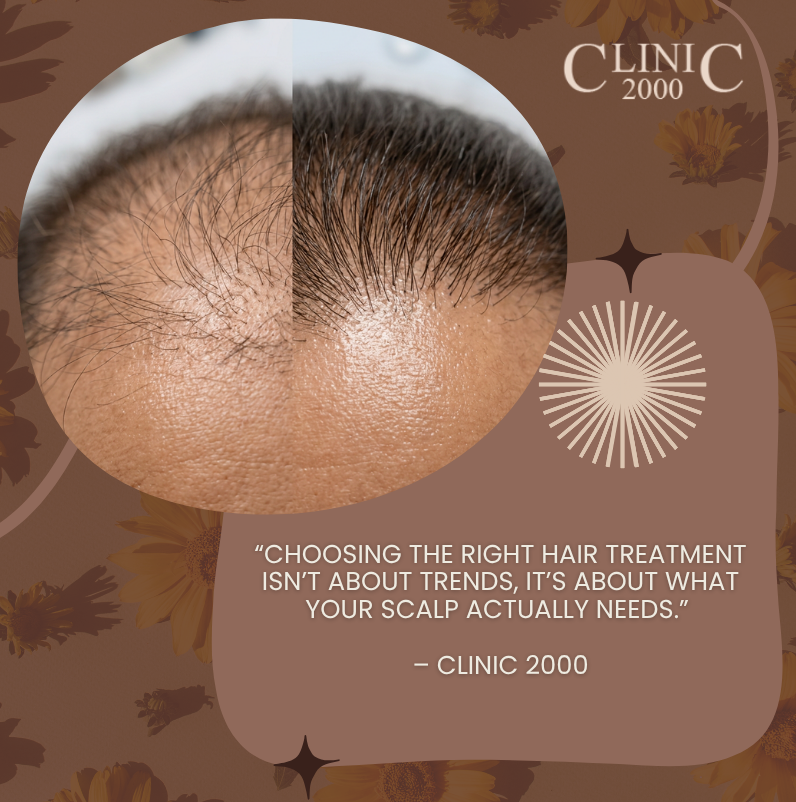
If you have been researching hair loss treatments, you have probably come across both PRP and GFC. Both involve injecting a concentrated solution derived from your own blood into the scalp. Both are non-surgical. Both claim impressive results. So how are they different and more importantly, which one is right for you?
This guide cuts through the confusion. We explain exactly how each treatment works, what science says about their effectiveness, who is best suited for each, and what you can realistically expect from either option at Clinic 2000 in Hyderabad.
Understanding Hair Loss: Why It Happens
Hair loss, medically known as alopecia affects both men and women, though the patterns differ. The most common form is androgenetic alopecia (pattern baldness), which is influenced by genetics and hormones. Other causes include nutritional deficiencies, stress, thyroid imbalances, scalp conditions, and post-pregnancy hormonal shifts in women.
At the core of most hair loss is the shrinkage of hair follicles, a process called follicular miniaturisation. When follicles shrink, the hairs they produce become thinner and shorter until they eventually stop producing hair altogether. Both PRP and GFC work by delivering growth factors directly to these weakened follicles to stimulate regeneration.
What Is PRP (Platelet-Rich Plasma)?
PRP stands for Platelet-Rich Plasma. It is one of the most widely used hair restoration treatments in the world and has been practiced for over a decade.
Here is how the procedure works:
• A small amount of your blood is drawn, typically 10 to 20 ml
• The blood is placed in a centrifuge machine and spun at high speed to separate its components
• This process isolates the platelet-rich plasma, the portion of blood with the highest concentration of growth factors
• The PRP is then injected into the areas of the scalp experiencing hair loss
Platelets contain growth factors such as PDGF, VEGF, and TGF-beta, which stimulate follicle activity, improve blood supply to the scalp, and extend the active growth phase of the hair cycle. Multiple sessions are typically needed usually 4 to 6, spaced a month apart followed by maintenance sessions.
What Is GFC (Growth Factor Concentrate)?
GFC, Growth Factor Concentrate is a newer, more refined technology that builds on the principles of PRP but takes the science a step further.
Here is how GFC differs:
• Blood is drawn and processed using a specialised closed-system kit
• Rather than simply separating plasma, the platelets are activated and the growth factors are extracted in a concentrated form
• The result is a highly purified growth factor concentrate that contains significantly higher levels of active growth proteins compared to standard PRP
• This concentrate is then injected into the scalp in a similar manner to PRP
Because the growth factors are isolated and concentrated rather than delivered within the plasma matrix, GFC is considered to have better targeted efficacy with less variability between sessions.
PRP vs. GFC: A Direct Comparison
Growth Factor Concentration
GFC contains a higher concentration of isolated growth factors compared to PRP. In PRP, growth factors are present within the plasma fraction; in GFC, they are specifically extracted and concentrated, making the treatment more targeted.
Purity
GFC has a higher purity as it removes red blood cells, white blood cells, and other components that are not therapeutic for hair restoration. PRP, depending on the system used, may contain some of these elements.
Pain and Discomfort
Both procedures involve scalp injections and are generally well tolerated with a topical numbing cream. GFC tends to be slightly more comfortable as the concentrate is less inflammatory than the whole PRP.
Number of Sessions
Both treatments typically require 4 to 6 initial sessions. Maintenance sessions are recommended every 3 to 6 months for sustained results.
Ideal Candidate
PRP is an excellent choice for early to moderate hair loss, patients new to biotherapy, or those with a tight budget. GFC is better suited for moderate to advanced hair loss, patients who have had limited success with PRP, or those seeking faster and more robust results.
Cost
PRP is generally the more affordable option. GFC costs slightly more per session due to the advanced processing kit and higher concentration, but many patients find fewer maintenance sessions are required over time.
What Results Can You Expect?
Both PRP and GFC are effective, the results depend on the extent and cause of hair loss, the number of sessions completed, and consistency of treatment.
Typical outcomes include:
• Reduced hair shedding within 2 to 3 sessions
• Noticeable increase in hair density and thickness by 3 to 4 months
• New hair growth in areas of thinning, particularly effective for early-stage pattern baldness
• Improved scalp health and reduced dandruff
GFC patients often report slightly faster and more consistent results, but both treatments have strong clinical backing for androgenetic alopecia and diffuse hair thinning.
Who Should Choose PRP?
• You are experiencing early-stage hair loss or mild thinning
• You have not tried any biotherapy before and want to start with an established treatment
• Budget is a consideration
• Your dermatologist recommends it after assessment
Who Should Choose GFC?
• You have moderate to advanced hair loss
• You have previously tried PRP with limited success
• You want a more targeted, purer treatment
• You are looking for faster visible improvement
Why Choose Clinic 2000 for PRP or GFC?
At Clinic 2000, both PRP and GFC are performed under the supervision of Dr. Ravindranath Reddy, a specialist in Medical Cosmetology and Trichology with over 28 years of clinical experience. We use fully sterile, closed-system kits and follow international protocols for both procedures.
Before recommending either treatment, our dermatologist conducts a thorough scalp analysis to determine the pattern, cause, and severity of your hair loss. This ensures you receive the most effective treatment for your specific condition not a generic recommendation.
Conclusion
Both PRP and GFC are safe, effective, non-surgical treatments for hair loss. PRP is a proven, established option for early-stage hair thinning, while GFC offers a more concentrated and potentially more potent alternative for those with greater hair loss or more complex cases.
The best way to decide between them is through a professional consultation. At Clinic 2000, our team will assess your scalp, review your hair loss history, and recommend the treatment most likely to give you the best results.
Book your consultation today and take the first step toward stronger, healthier, fuller hair.
Frequently Asked Questions
Q: Is PRP or GFC painful?
Both procedures involve scalp injections and a topical numbing cream is applied beforehand. Most patients describe the sensation as mild discomfort rather than pain.
Q: How soon will I see results from PRP or GFC?
Initial reduction in shedding is usually noticeable within 2 to 3 sessions. Visible density improvement typically appears between months 3 and 6.
Q: Can women get PRP or GFC for hair loss?
Absolutely. Both treatments are equally effective for female pattern hair loss and diffuse thinning in women.
Q: How many sessions are needed?
Typically 4 to 6 sessions for the initial course, followed by maintenance sessions every 3 to 6 months to sustain results.
Q: Can PRP or GFC be combined with other hair loss treatments?
Yes. They are often combined with topical solutions, nutritional supplements, or anti-dandruff treatments for comprehensive results. Our team will advise the best combination for your case.