


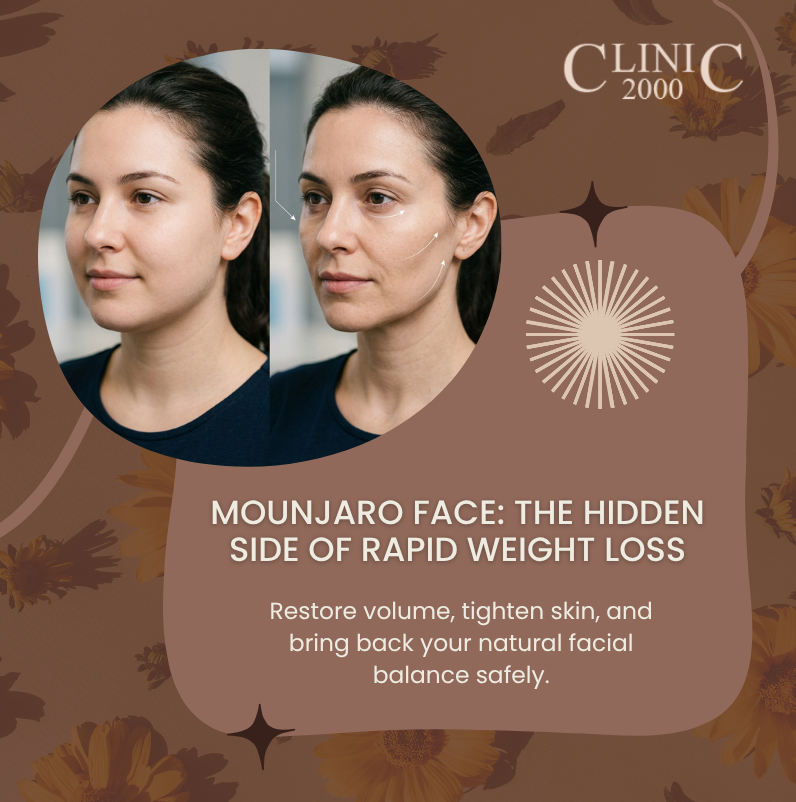
Mounjaro (tirzepatide) is making headlines across the world and now, across India. As one of the most powerful weight-loss medications currently available, it is helping thousands of people achieve significant fat reduction in a matter of months. But alongside the impressive results, a new conversation is emerging: what happens to your face?
If you have heard of ‘Ozempic Face’, the gaunt, hollowed appearance that some people develop during rapid weight loss on GLP-1 medications, ‘Mounjaro Face’ is the same phenomenon, and it can be even more pronounced. That is because Mounjaro works on two receptors (GIP and GLP-1) rather than one, making it more potent and capable of producing faster, more dramatic fat loss that the skin cannot always keep pace with.
In this blog, we explain exactly what Mounjaro Face is, why it happens, who is most at risk, and what treatments are available, including the options at Clinic 2000 in Hyderabad to restore your facial appearance without compromising your weight loss journey.
What Is Mounjaro Face?
Mounjaro Face is not an official medical term, but it describes a very real aesthetic experience. When people lose significant weight rapidly as many do on tirzepatide, the body draws from fat stores all over, including the face. The fat pads on the cheeks, temples, under the eyes, and around the jawline give the face its youthful, full structure. As these fat deposits shrink, the overlying skin, which has not had time to contract and adapt begins to sag, wrinkle, and look hollow.
The result is a face that can look significantly older than before the weight loss: deeper nasolabial folds (the lines from nose to mouth), sunken cheeks, loose skin around the jaw, visible temples, and under-eye hollowing. You may have lost weight on your body but look like you have aged five to ten years on your face.
Why Does It Happen?
The Speed of Fat Loss
Mounjaro has demonstrated up to 20 to 22 percent body weight reduction in clinical trials, significantly more than older medications. That kind of rapid fat loss gives the skin very little time to adapt. Skin elasticity depends on collagen and elastin, and these structures need time to contract as volume reduces. When fat disappears faster than collagen can respond, the skin hangs loose over the newly reduced structure underneath.
Facial Fat Is Structurally Important
Unlike the fat on your abdomen or thighs which is mostly padding, facial fat serves a structural role. It fills compartments that define facial contours: the apple of the cheek, the fullness above the jawline, the cushion beneath the eyes. Once these compartments deflate, the face loses its architecture entirely.
Age and Skin Elasticity
Older individuals and those whose skin has already lost elasticity due to sun damage, smoking, or previous significant weight fluctuations are far more susceptible to visible Mounjaro Face. Younger skin with good collagen density tends to adapt more readily to volume changes.
Mounjaro vs. Ozempic – Which Is Worse for the Face?
Because Mounjaro’s dual mechanism produces faster and more pronounced fat loss than semaglutide (Ozempic), the facial changes it induces tend to appear sooner and be more significant. Patients who lose 15 to 20 kilograms in 6 months are far more likely to see dramatic facial changes than those who lose the same amount over 18 months.
Who Is Most at Risk?
• Adults over 40, reduced collagen and elastin mean skin adapts more slowly
• Those who lose more than 10 percent of their body weight rapidly
• People with existing sun damage or chronically dehydrated skin
• Individuals who have undergone previous significant weight loss and regain
• Those with naturally slim faces and less baseline facial fat reserve
What Can You Do About It?
The good news is that Mounjaro Face is treatable. The approach depends on the severity of the changes and whether you are still actively losing weight or have reached your target. Importantly, you do not need to choose between your weight loss goals and your facial appearance, the right clinical interventions allow you to address both.
1. Collagen-Stimulating Treatments
Treatments that stimulate the skin to produce new collagen help rebuild the structural support around facial pores, tighten loose skin, and improve texture. At Clinic 2000, HIFU (High-Intensity Focused Ultrasound) is one of the most effective non-surgical options for this. HIFU reaches the deep dermal and subdermal layers of skin, precisely where collagen remodelling occurs and delivers long-lasting tightening results with no downtime.
Microneedling is another excellent option, using controlled micro-injuries to trigger the skin’s natural collagen repair response. It is particularly effective for skin texture, fine lines, and mild to moderate laxity from weight loss.
2. HydraFacial and Skin Rejuvenation
Skin that has undergone rapid fat loss often becomes dehydrated and dull. HydraFacial treatments simultaneously hydrate, nourish, and rejuvenate the skin, improving its quality and resilience while the collagen rebuilds. Regular HydraFacial sessions during and after weight loss help maintain skin health throughout the journey.
3. Targeted Skincare
A home skincare routine rich in Vitamin C (collagen support), retinol (skin renewal), hyaluronic acid (hydration), and SPF (preventing further collagen breakdown from UV) can significantly support in-clinic results. Our dermatologists at Clinic 2000 can advise a personalised routine suited to your skin type and stage of weight loss.
4. Paced Weight Loss Where Possible
From a medical obesity management perspective, slower, more gradual weight loss, even on a medication like Mounjaro gives the skin more time to adapt. Our bariatric physician at Clinic 2000 can help optimise your dosage and nutritional protocol to support both effective fat loss and skin health simultaneously.
How Clinic 2000 Can Help
At Clinic 2000, we are uniquely positioned to address both sides of this challenge. As South India’s first dedicated bariatric and obesity treatment centre, we have decades of experience managing medically supervised weight loss. At the same time, our dermatology and cosmetology expertise means we can treat the aesthetic consequences of rapid fat loss including Mounjaro Face with the same clinical rigour.
If you are on Mounjaro or another GLP-1 medication and are noticing facial changes, book a dermatology consultation with us. We will assess your skin’s current state and recommend a combination plan which may include HIFU, microneedling, HydraFacial, or a targeted skincare protocol to restore your facial vitality while you continue working toward your weight goals.
Conclusion
Mounjaro is a breakthrough for weight management but like all powerful tools, it comes with considerations. Mounjaro Face is a real and increasingly common aesthetic concern as more people in India and around the world adopt GLP-1 medications for obesity treatment. The good news is that it is manageable. With the right clinical support, you can achieve your weight loss goals and still look like the best version of yourself.
Clinic 2000 has been helping patients look and feel their best for over 28 years. If weight loss is changing your face in ways you did not expect, speak to our team today.
Frequently Asked Questions
Q: Is Mounjaro Face permanent? No. With the right treatments, the appearance of Mounjaro Face can be significantly improved. Collagen-stimulating treatments, skin tightening procedures, and good skincare can restore much of the facial volume and firmness lost during rapid weight loss.
Q: Can I prevent Mounjaro Face while still losing weight? You can reduce its severity by losing weight gradually, maintaining excellent nutrition (especially protein intake), staying well hydrated, protecting skin from UV damage, and undergoing preventive collagen-stimulating treatments during your weight loss journey.
Q: Does everyone on Mounjaro experience facial changes? No. The extent of facial changes depends on how much weight is lost, how quickly, your age, and your skin’s baseline elasticity. Some individuals experience minimal changes; others find it more pronounced.
Q: Is HIFU safe for Mounjaro Face treatment? Yes. HIFU is a non-invasive, FDA-approved technology that stimulates collagen deep within the skin. It is one of the most effective treatments for skin laxity following weight loss.
Q: Should I wait until I finish losing weight before treating Mounjaro Face? Not necessarily. Many patients benefit from proactive skin treatments while they are still on medication. Our dermatologist will advise the best timing based on your individual progress.