


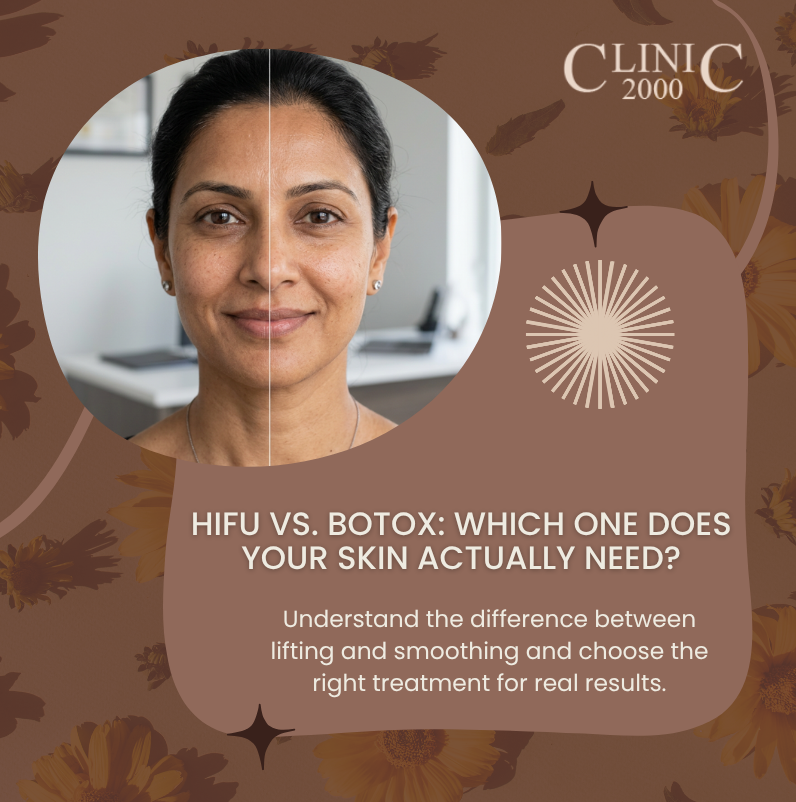
If you have been noticing sagging skin, deepening wrinkles, or a face that is starting to look heavier and less defined than it once did, you are probably familiar with two names that come up constantly: HIFU and Botox. Both are non-surgical. Both are widely available. Both are marketed as anti-ageing solutions.
But they are fundamentally different treatments that work in completely different ways and choosing the wrong one for your skin concern can leave you disappointed and out of pocket. In this guide, we explain exactly how HIFU and Botox work, what each one does well, who each one suits, and which combination approach delivers the best results.
How Does HIFU Work?
HIFU stands for High-Intensity Focused Ultrasound. It uses focused beams of ultrasound energy to penetrate the skin at precisely calibrated depths reaching the deep dermis and the SMAS layer (the superficial muscular aponeurotic system), which is the same structural layer that surgeons tighten in a facelift.
The focused energy creates controlled thermal injury points at these target depths. The body’s natural healing response produces new collagen and elastin at these points, progressively tightening and lifting the skin over a period of 2 to 3 months. One session delivers results that continue to improve over 90 days and can last 12 to 18 months.
HIFU does not change anything on the surface of the skin, the treatment happens entirely beneath it. This means there is no downtime, no visible recovery, and no disruption to daily activities. The technology at Clinic 2000 is FDA and CE approved, and results are clinically validated.
How Does Botox Work?
Botox is the trade name for botulinum toxin, a purified protein that temporarily relaxes specific facial muscles. When injected into a target muscle, it blocks the nerve signals that cause that muscle to contract. The overlying skin smooths out because the muscle beneath it is no longer pulling it into a wrinkle.
Botox works quickly, results appear within 3 to 7 days and typically last 3 to 6 months. It is extremely effective for ‘dynamic wrinkles’, the wrinkles that form during facial expressions such as frown lines between the brows, forehead lines, and crow’s feet around the eyes.
Critically, Botox relaxes muscles. It does not tighten skin, build collagen, or lift structural tissue. Once the muscle effect wears off, the wrinkles return, and repeat treatments are needed.
HIFU vs. Botox: A Direct Comparison
What They Treat
HIFU is best for skin laxity, loss of facial definition, jowls, a heavier or sagging jawline, and neck looseness. It addresses the structural causes of facial ageing, collagen loss and tissue descent.
Botox is best for expression lines and dynamic wrinkles. Forehead lines, crow’s feet, frown lines, bunny lines on the nose, and lip lines caused by repeated muscle movement are all ideally suited to Botox.
Longevity of Results
HIFU results develop gradually over 2 to 3 months and can last 12 to 24 months with a single treatment session. Botox results appear quickly but last only 3 to 6 months, requiring repeat sessions to maintain.
Discomfort
HIFU treatment involves a warming or prickling sensation as ultrasound energy is delivered. Most patients find it very tolerable. Botox involves small injections that cause brief, mild discomfort at the injection sites.
Ideal Candidate
HIFU is most effective for patients in their mid-30s to 60s experiencing moderate to significant skin laxity, jowling, or neck looseness. It is a better choice for structural lifting and tightening.
Botox suits patients who are bothered primarily by expression lines and want a quick, effective fix with minimal commitment. It is an excellent choice from the late 20s onward for dynamic wrinkles.
Cost
Because HIFU results last considerably longer than Botox, the per-year cost can be similar or even lower despite a higher per-session price. Over a three-year period, a patient who maintains Botox every 4 months will typically spend more than a patient who has one annual HIFU session.
Can HIFU and Botox Be Combined?
Yes and in many cases, this is the ideal approach. HIFU tightens and lifts the structural foundation of the face. Botox addresses the surface expression wrinkles that HIFU does not treat. Together, they cover the full spectrum of facial ageing, structural descent and dynamic wrinkling without surgery.
At Clinic 2000, our dermatologist can evaluate your skin and recommend whether HIFU, Botox, or a combination approach is most appropriate for your specific concerns and goals.
Why Choose Clinic 2000 for HIFU?
At Clinic 2000, we use HIFU technology that is FDA and CE approved, the same standard used internationally. Dr. Ravindranath Reddy and our clinical team have over 28 years of experience in non-surgical skin treatments. Every HIFU treatment is performed after a detailed skin assessment to determine the correct energy levels, depth settings, and treatment zones for your individual skin.
We also offer HIFU Liposonix for body contouring, the same ultrasound technology applied to stubborn fat deposits on the body. For patients interested in addressing both facial ageing and body concerns in one visit, Clinic 2000 is uniquely equipped to help.
Conclusion
HIFU and Botox are both excellent anti-ageing tools but they do different things. HIFU lifts, tightens, and rebuilds. Botox relaxes and smooths. Choosing between them starts with understanding what is actually ageing your face, not just which treatment you have heard the most about.
Book a consultation at Clinic 2000 today. Our team will assess your skin, explain what is driving your specific concerns, and recommend the treatment or combination that will give you the most natural, effective, and lasting results.
Frequently Asked Questions
Q: Is HIFU painful? Most patients experience a warming or tingling sensation. The treatment is well-tolerated, and any mild discomfort passes quickly. No anaesthesia is required.
Q: How long does one HIFU session take? A full face and neck HIFU treatment typically takes 60 to 90 minutes. There is no recovery time required.
Q: When will I see results from HIFU? Initial tightening may be noticeable soon after treatment, but the full result develops progressively over 2 to 3 months as new collagen forms. Results typically last 12 to 18 months.
Q: Is there any downtime after HIFU? No. You can resume all normal activities immediately. Mild redness or swelling may occasionally occur and resolve within a few hours.
Q: At what age should I start HIFU? HIFU is appropriate from the mid-30s onward when early signs of skin laxity begin. Starting earlier helps maintain skin structure; later treatments are equally effective for more advanced laxity.